 Board Portal
 Board Performance
 M&A & Transactions



 Board Management Software
 Customer stories
 Insights
 Events & Webinars
 Security & Privacy
 Product updates






 Login
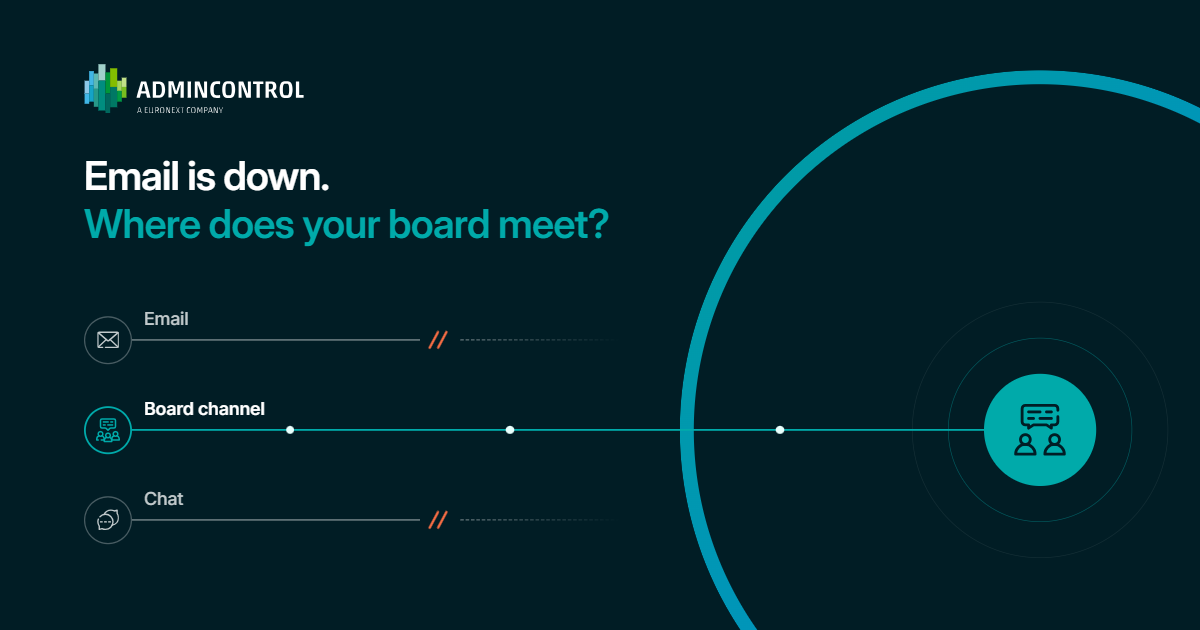 On Thursday afternoon, millions of people opened Outlook and found nothing there. A global Microsoft outage cut off email in 74 countries and territories, disrupted Teams, and was still not fully fixed the next morning, after the company said its first fixes were not taking as expected.
For most staff, that meant a frustrating day. For a board, it is a question worth asking now: if the channel fails at the very moment you need to decide, how does the board keep working?
Crises are exactly when boards need to talk most. A cyberattack, a profit warning, an unexpected takeover approach, the sudden departure of a CEO: each one calls for fast, confidential discussion and a clear record of who decided what. And each one is also a moment when the usual channels are most likely to be unavailable, overloaded or untrustworthy.
Three ways a board loses its channel
1. The channel is down. This is what happened this week. Email and chat stop working, and nothing gets through until the provider recovers. The disruption is visible, and everyone knows it is happening.
2. The channel is there, but can't be trusted. In a cyberattack, the more dangerous scenario is that email keeps working while someone else is reading it. The UK's National Cyber Security Centre tells organisations under attack to first establish whether their communication channels are available and can be trusted, and to set up alternative ways to communicate if they can't. A board discussing its response to a breach over the compromised mailbox is briefing the attacker.
3. The channel is switched off on purpose. During an incident, the IT team may disconnect or shut down systems to contain the damage. The board loses its email at the same moment it is asked to approve the response.
There is a fourth trap that cuts across all three: the backup that isn't one. If the "alternative" is a chat tool that runs on the same platform, signs in through the same identity system or lives on the same network, it fails together with the main channel.
The workaround is where control is lost
When the usual channels go dark, directors don't stop communicating. They improvise: a personal email account, a group chat, a text message with a board paper photographed on a phone.
Every one of those moves takes confidential board information outside the access controls and the record that good governance depends on. You can no longer see who received what, you can't withdraw it, and months later you may not be able to show how a decision was reached.
That record matters more than it seems in the moment. The NCSC advises keeping a single authoritative record of what was found, which decisions were taken and by whom, noting that regulators and insurers may ask for it. Decisions made on personal phones rarely make it there.
Regulators already expect a plan
For a growing number of European boards, this is no longer only good practice.
Financial entities under DORA must have crisis communication plans for major ICT-related incidents (Article 14), and those incidents must be escalated to the management body (Article 17).
Essential and important entities under NIS2 need management bodies that approve and oversee cybersecurity risk measures, including business continuity and crisis management, and that can be held liable for failures (Articles 20 and 21).
The NCSC has told UK companies to keep incident response plans offline or on paper, with measures to communicate without access to systems and the internet.
A crisis communication plan that assumes email works is a plan for a crisis that never comes.
Five principles for board communication continuity
Give the board a channel of its own. Board communication should not depend on the same infrastructure as everyday email. Ask where it is hosted, how directors sign in, and whether it keeps working if the corporate network is down or compromised.
Decide in advance who calls it. Agree who can declare the usual channels unusable or untrusted, and where the board moves when they do. In the middle of an incident is too late to debate it.
Keep the essentials within reach offline. Directors' contact details, the crisis plan and the latest board materials should be available without a working network: on paper, or on a device that stores them locally.
Keep the record while it happens. Even an emergency call should produce a dated note of who attended, what was decided and why, kept somewhere access-controlled, so the minutes can be approved properly afterwards.
Rehearse the loss of the channel. Add "email is down" and "email is compromised" to the next crisis exercise. A director who has never opened the board app will not learn to use it during a crisis.
None of this requires a large budget. It does require a decision, taken by the board, before it is needed.
Where a board portal fits
A dedicated board portal is one way to put the first and third principles into practice. It is not a full crisis plan on its own: a phone tree, an offline copy of the plan and a rehearsed decision process still matter.
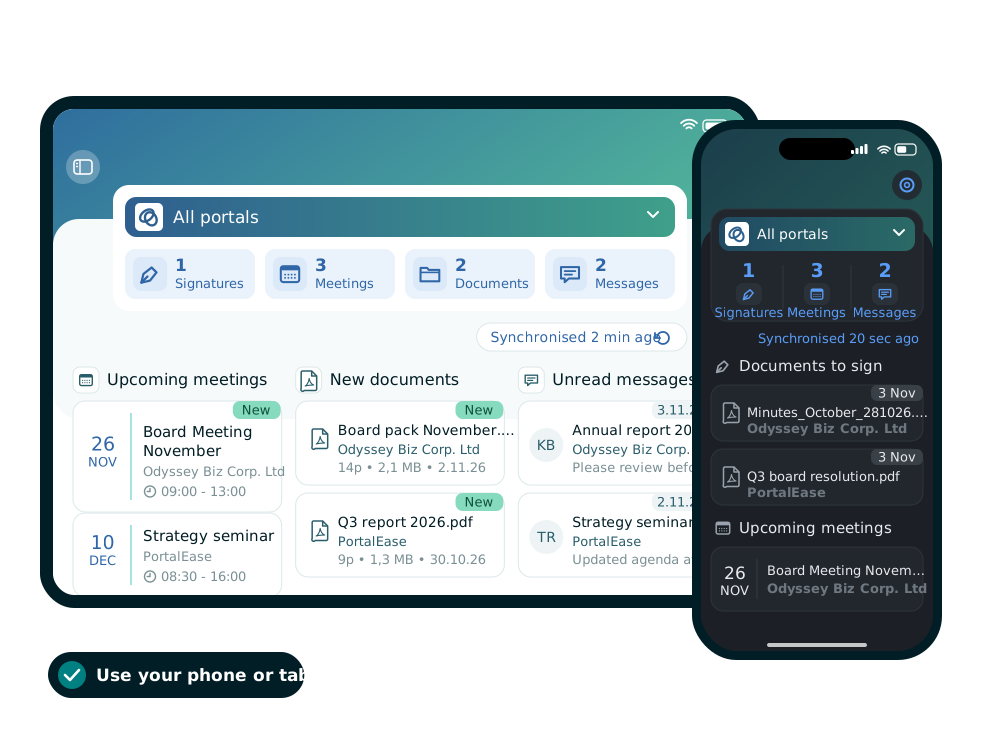
Admincontrol Board Portal was built as that separate channel. Board documents are stored on Admincontrol's own hardware in two data centres in Norway, in the European Economic Area, encrypted with a separate key for each client. Directors can talk through secure messaging inside the portal rather than in email or chat apps, and the Admincontrol app keeps the last 30 days of board materials synced for offline reading. During this week's outage, the portal has kept running as usual.
More than 7,500 boards use Admincontrol, and the platform holds ISO/IEC 27001:2022 certification and an annual SOC 2 Type II report from independent auditors.
A question for your next board meeting
If your email were down, or quietly compromised, tomorrow morning: where would this board meet, how would directors know a message really came from the chair, and where would the decision be recorded?