
 Boards & Governance
 M&A & Transactions

.png)
.png)
 Board Management Software
 Customer stories
 Insights
 Events & Webinars
 Security & Privacy
 Product updates

.jpg)



-Jul-03-2026-06-32-50-9626-AM.png)
 Login
Login
-min.jpg?width=5760&height=3840&name=shutterstock_1043892265-2%20(1R)-min.jpg)
As CFO, you're at the center of both the financial story and the strategic risks behind any transaction. When a deal is underway, that responsibility comes into even sharper focus.
The information you oversee (financial models, cap tables, debt structures, and forecasting assumptions) is the same information that has the biggest impact on valuation. The way it's managed, shared, and protected can influence not only the success of the transaction, but also your organisation's level of risk and exposure throughout the process.
This guide covers what CFOs need to know about virtual data room strategy, confidential deal room software, and the controls that matter most when the stakes are highest.
Why Confidential Deal Room Software Is a CFO Priority
The term "data room" undersells what a modern VDR platform does. For a CFO, a virtual data room is a controlled information environment. It enables precise sharing with other parties while maintaining full visibility over who has seen what.
Confidential deal room software matters to CFOs for three specific reasons:
-
Financial data is uniquely sensitive. Once detailed information such as financial models, cap tables, or forecasts have been shared with a potential buyer, investor, or partner, there is no way to take it back. That's why the rules around who can access, download, and distribute documents need to be in place before any information is uploaded.
-
Audit trails provide protection. If questions arise during or after a transaction, being able to show exactly what was shared, when it was shared, and who had access to it can be invaluable. A professional virtual data room automatically creates this record, helping protect both your organisation and your reputation.
-
Efficiency directly affects deal outcomes. Every extra week spent in due diligence comes at a cost. A well-organised data room helps keep the process moving and can significantly reduce the time required to complete a transaction.
Document Security for Business Transactions: The CFO's Checklist
What does best-practice document security look like during a live transaction? It's important to choose a VDR like Admincontrol that contains and allows the following:
- Access by role. The acquirer's financial advisors see financials. Legal advisors see contracts. No one sees everything unless you decide they should.
- Every downloaded document carries the recipient's identity. If a document appears where it should not, you know the source.
- Access can be withdrawn instantly. If a counterparty exits the process or a confidentiality concern arises, documents become inaccessible with a single action.
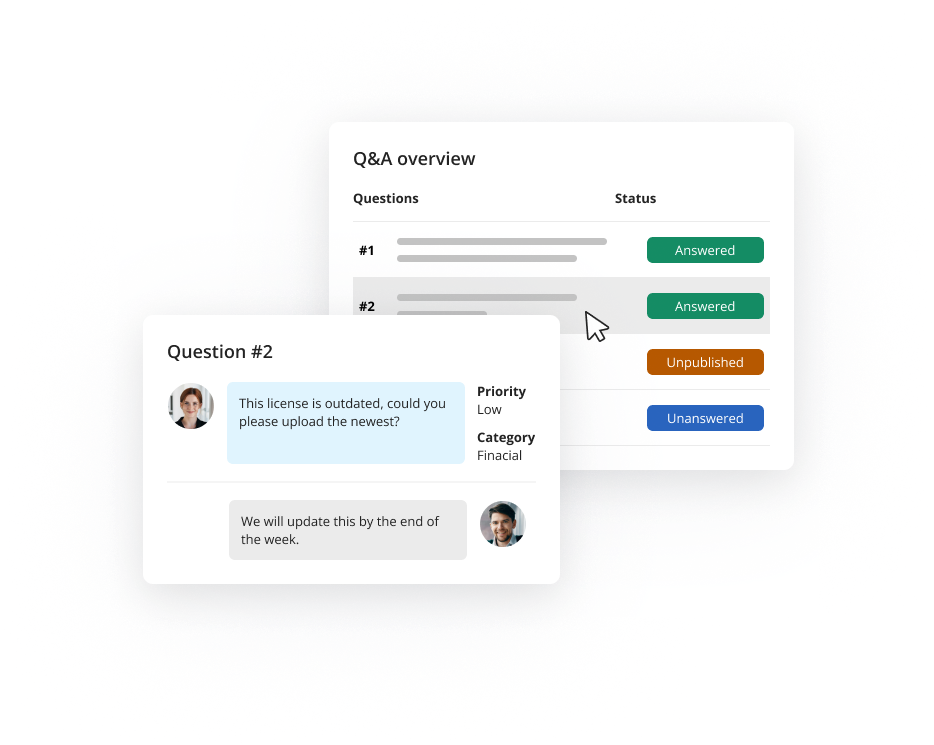
- All questions from counterparties are logged, assigned, and tracked within the platform. No sensitive information is shared outside the controlled environment.
- See which documents have been viewed, by whom, and for how long. This intelligence helps you anticipate where questions will come from and prepare your team accordingly.
How to Securely Share Sensitive Business Documents at Scale
One of the most common failure in transaction due diligence is the informal data room: email chains, shared drives, and ad hoc file transfers that create an uncontrolled and unauditable document trail. For a CFO, this is not just operationally inefficient. It is a liability.
Admincontrol's VDR enables CFOs to share sensitive business documents with the confidence that comes from enterprise-grade security, without the friction that slows down counterparties or creates bottlenecks for your own team.
The platform supports:
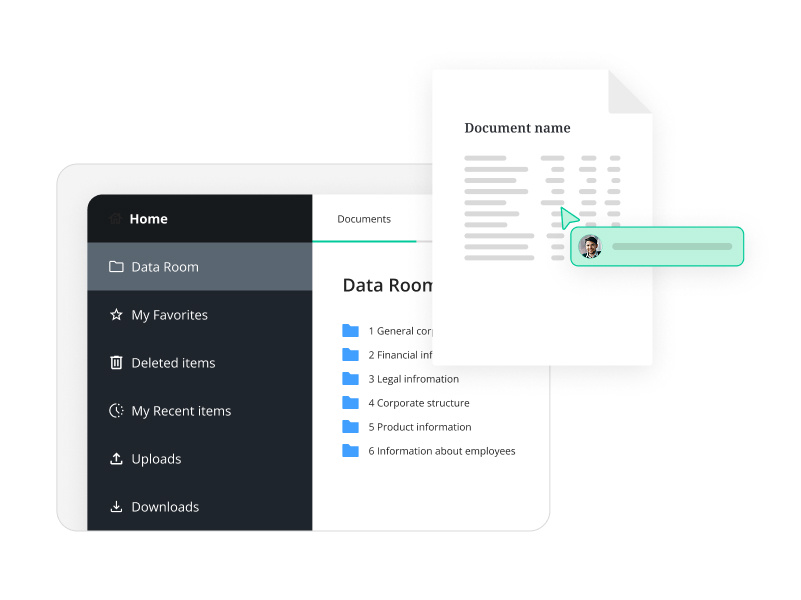
- Bulk document upload and automated index generation
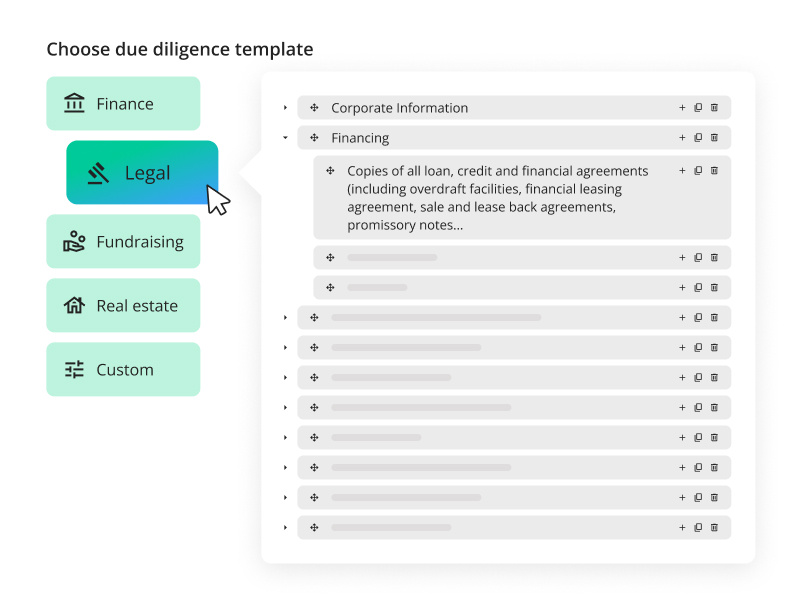
- Customisable folder structures aligned to standard due diligence frameworks
- Multi-party access with independent permission sets for each group
- Integrated NDA management before any document access is granted
Virtual Data Room for M&A Due Diligence: What CFOs Should Prepare
The CFO's preparation for M&A due diligence typically centres on financial statements, forecasts, and the cap table. But experienced CFOs know that the financial workstream is only part of what drives due diligence complexity.
The documents that generate the most questions (and the most delay) are often the ones that sit at the boundary of finance and operations: customer contract economics, revenue recognition policies, contingent liabilities, pension obligations, and intercompany arrangements.
A well-prepared Admincontrol data room for M&A due diligence will include:
- Three to five years of audited financial statements and management accounts
- Board-approved budgets and rolling forecasts
- Detailed cap table with all share classes, options, and convertible instruments
- Debt documentation, facility agreements, and covenant schedules
- Material contracts with revenue and cost implications
- Tax returns and any open queries with revenue authorities
- Related-party transactions and transfer pricing documentation
Enterprise Virtual Data Room Solutions for Financial Leaders
Not all VDR platforms are built with the CFO's requirements in mind. Consumer-grade file sharing tools and generic cloud storage are not appropriate for transaction environments. The gap is not just security, it is governance, accountability, and professional counterparty experience.
Enterprise virtual data room solutions like Admincontrol are differentiated by:
- Compliance infrastructure aligned to GDPR and sector-specific requirements
- Dedicated support from teams with M&A transaction experience
- Platform stability and uptime guarantees appropriate for live deal timelines
- Integration with the board portal environment for seamless governance continuity post-transaction
For CFOs who manage transactions regularly, the ability to retain and reuse a structured data room environment (rather than rebuilding from scratch each time) is a material efficiency gain.
Executive Level VDR Software: The CFO-CEO Alignment
One of the underappreciated benefits of executive-level VDR software is the alignment it creates between the CFO and CEO during a transaction. When both leaders are working from the same platform (with the same visibility into counterparty engagement, document access, and outstanding information requests) their ability to manage the process together is significantly enhanced.
Admincontrol's platform is designed for this. The CFO manages the document environment. The CEO maintains visibility over engagement and pace. The board receives updates through the same secure environment. There are no information asymmetries, no version control issues, and no uncertainty about what has been shared.